Terence McKenna Birthday Raffle Winners

The Terence McKenna Birthday Raffle is over and the winners have been selected, contacted, and confirmed.

The first prize winner is: Graham St. John9781583947326

He wins the full set of 17 (5×5) Chip Simons photographs of Terence in front of his library from the Terence McKenna Archives crowdfund plus three bookmarks.

(FYI, Graham’s book, ‘Mystery School in Hyperspace: A Cultural History of DMT’ has some really nice research on Terence that you won’t find elsewhere, among many other virtues. As a nice synchronicity, I just so happened to receive the archive’s copy of Graham’s book yesterday on Terence’s birthday while the raffle was in full swing.)

The runner-up winner is: Jeff Lerue

He wins one 8×8 photo of his choice–he’s having a tough time deciding–plus one bookmark.

For those of you who didn’t win, thank you so much for participating, and please know that your donations will allow the Terence McKenna Archives to grow. Before the end of the year, I’ll write a blog post detailing what was added to the collection using the proceeds from the raffle.

The photos, along with buttons, magnets, and bookmarks can still be purchased from the Etsy shop on their own even though the raffle is over. As always, all proceeds go to further the development of the archival project.

https://www.etsy.com/shop/TerenceMcKennaArkive

Thanks everyone for supporting The Terence McKenna Archives!

Terence McKenna Birthday Raffle

In honor of Terence’s birthday (Nov. 16), The Terence McKenna Archives is holding a raffle for a full set of 17 photos (5×5 inches) and three bookmarks from the photo shoot Terence did with photographer Chip Simons in the early 1990s in front of his home library in California (value = $130). Each raffle ticket costs $1 and the winner will be chosen at noon (PST) on November 17. A second raffle winner will win one 8×8 inch photo of their choice (from the set of 17) plus one bookmark.

Obviously, the more tickets you purchase, the better your chances. Any profits from the raffle go directly back into the development of the Terence McKenna Archives. $1 = 1 Ticket, $5 = 6 Tickets, $10 = 13 Tickets, $20 = 30 Tickets. Winning tickets include free shipping within the U.S. and free shipping internationally. After the raffle, we’ll make a post to show what we were able to add to the collection using any proceeds gained.

Please SHARE wherever appropriate!

You can purchase raffle tickets here: https://www.etsy.com/listing/572572761/terence-mckenna-birthday-raffle?ref=shop_home_active_2

Thanks for your support and good luck!

Otherwise, here’s a favorite essay by Terence where he describes his 25th birthday in 1971…

And, here’s a selection of the photos that are being raffled:

Terence McKenna Archives – Random Item #30 – Bruce Eisner’s Dedication to Terence McKenna

Today’s random item from the archives comes from an issue of the magazine (no longer in production) Psychedelic Island Views, which was edited by “long-time and notorious member of the psychedelic community,” Bruce Eisner. The issue itself has a bit of an identity crisis: the cover lists it as “Volume 3, Issue 1,” while the footer at the bottom of DSCF8479each page inside the magazine says “Volume 2, Issue 2.” To compound the schizophrenia even further, in Eisner’s own dedication to the volume (and to Terence), he refers to it as “this second issue of Psychedelic Island Views.” How a “second issue” could be either “Volume 3, Issue 1” or “Volume 2, Issue2” is still a bit beyond me.

Indeed, as Walt Whitman sings of himself (and each of us by extension):

Do I contradict myself?
Very well then I contradict myself,
(I am large, I contain multitudes.)

DSCF8485

The relevant part of this multitudinous magazine that I am sharing with you today is Eisner’s Dedication to Terence McKenna, which opens this 1997 issue…..whichever issue it happens to be.

dscf8482.jpg

There is actually a lot in this dense ode, including some interesting data points for those who are paying particularly close attention to Terence’s timeline. As an example, Eisner mentions having met Terence in July, 1982 at a party that was affiliated with the Colloquium II: The Future of Consciousness conference. He doesn’t make clear whether or not Terence was a speaker at the conference or not, but if he was, this would have been one of his very earliest public talks. If Terence didn’t talk at the conference, it’s still an important meeting point between him and other major figures in the psychedelic community. If anyone attended this conference and has photos, recordings, or memories of the event, please do contact me and let me know what you recall.

Here’s a photo of Eisner’s dedication to Terence, followed by a transcription of the text:

dscf8481-e1510789623980.jpg

This second issue of Psychedelic Island Views carries on our tradition of honoring individuals who have contributed to psychedelic cultural experiment, proposed first by Aldous Huxley. We dedicate this issue to Terence McKenna, the bard and philosopher who has during the past decade been responsible for a resurgence of interest in the psychedelics and the experiences they engender by men and women around the globe.

I first met Terence McKenna during a party surrounding a conference, Colloquium II: The Future of Consciousness, in July 1982 at U.C. Santa Cruz. The conference featured a wide assortment of speakers including Stanislav Grof, Stanley Krippner, Timothy Leary, Frank Baron, Ralph Metzner, Elizabeth Rauscher and many others. The event was a follow-up, 3 years after we had presented Albert Hofmann in the same venue at a mega-meeting called LSD–A Generation Later, the first and only psychedelic conference of the ‘Seventies.

I had read Invisible Landscape in its hardbound form and was fascinated by Terence and his brother Dennis’ account of their Ayahuasca experience in the South American jungle, which Terence later exfoliated in his first spoken book and later written book, True Hallucinations. When I met Terence, he was a quiet figure in the background, doing a kind of Carlos Castaneda and quietly publishing books about the psychedelics that he held sacred. A second book authored by his brother and Terence under the pseudonym Oss and Oeric called the Psilocybin Mushroom Grower’s Guide had done a great deal to make available to the public important psychotropic fungi which previously had only been read about by most of our community.

Terence and I had an instant “connection.” What I didn’t know when I first met him, aside from the lively conversation we had at the party that night, was that along with Timothy Leary, this was another Irishman who had kissed the Blarney Stone. Since that night, Terence has lectured around the globe, holding audiences mesmerized by his talks on a variety of unusual topics.

One lecture I was invited to, that was sponsored by Mondo 2000, concerned a theme which has remained constant with Terence, his theory that there is a fractal harmonic based on the I Ching, which when combined with predictions found in the Mayan Calendar points to the ending of history as we know it in the year 2012. He even has developed a software program which allows us to explore rises and falls in “novelty” of events as we approach the “rotating object, which hovers at the end of time.”

The latest predictions are incorporated into his beautiful World Wide Web site Hyperborea (http: http://www.levity.com/eschaton/hyperborea.html), which begins, “You have entered an Alchemical Garden at the Edge of Time. There is haze upon the distant hills; spreading Acacias bend low over reflecting pools. The air is filled with an all-pervasive hum; these are the reveries of the Proustian bees. Your guide will be gardener/curator, Terence McKenna.”

Master Web Artist Dmitri Novus has also created a rich Terence McKenna space as part of his The Deoxyribonucleic Hyperdimension (http://www.deoxy.org).

Another lecture I attended was about Terence’s theory that the magic mushroom was a much-used part of our tribal past. This view is expressed in his book Food of the Gods, McKenna believes that our past several thousand years have been a fall from our Dionysian, tribal, psychedelic past and that we are headed for an Archaic Revival, the subject of a series of essays and interviews in a book by the same name.

McKenna is also a close friend with Chaos Theorist Ralph Abraham, a professor of mathematics at my alma mater, U.C. Santa Cruz, and has conducted wide-ranging discussion with him and English biologist Rupert Sheldrake that was published in another recent book, Trialogues.

As you can see, Terence has indeed filled our ears and eyes with many words in the 15 years since we first met. Not content to rest on his laurels, he has published a number of recent articles about the link between the Internet and the psychedelic experience and is currently working on a new book about the future. At the same time a poet and a scholar. We are proud to dedicate this issue to one of the most significant spokesmen of a new generation of leaders of Island’s community of like-minded folk in search of a new culture.

Bruce Eisner

And a few advertisements that I found throughout the rest of the issue:

DSCF8491

Terence McKenna Music


Terence McKenna is among the most-sampled voices in the world of psychedelic electronic music. I actually suspect he is the single most-sampled individual, but am willing to admit that my position on this may be skewed by my own availability heuristic as his archivist. I would actually be quite interested to hear from any of you reading this if you think that there might be other contenders (for instance, it seems to me that Alan Watts, Robert Anton Wilson, and Timothy Leary are significantly less-sampled, comparatively). Since I’ve been tracking this phenomenon to the best of my ability for many years now, I thought it only appropriate to share some of the fruits of that effort with the audience of the Terence McKenna Archival Blog.

Here, then, are a series of YouTube Playlists, in which I have segregated a few different styles of music into which Terence McKenna has been sampled. I would be greatly obliged to anyone who can help me fill in these playlists with music that I didn’t know about. If you are an artist or label who has an album containing relevant samples and would like to donate a physical copy to be housed in the archives, please email terencemckennaarchives@gmail.com.

Please support these artists by purchasing their work and going to their events!

The first and most extensive (and my personal favorite) is the “Downtempo” Playlist, which consists predominantly of psychedelic downtempo/chillout music. This is a great playlist to just leave running in the background if you want a chill environment with occasional bits of Terence woven in:

The next playlist also consists of psychedelic electronic music but of the more fast and driving, high BPM, 4/4 beat, “Psytrance” genre. This playlist is less complete than the downtempo playlist; expect it to fill up more over time:

Finally, I have a playlist that includes “Everything Else”:

Enjoy12764703_259324984399663_2745639255830619150_o!

Here are some of my favorite individual songs from among these playlists (mostly from the downtempo):

Some Terence Hip-Hop:

Some Clubby Terence:

Whatever you’d call this light-hearted tribute:

And, probably the most high-profile artist who mentions (but doesn’t sample) Terence McKenna is Sheryl Crow in her song ‘Chances are’ from her ‘Wildflower’ album, which has the verse:

Sheryl Crow01

The Hallucinogeneration Game – Terence McKenna & The Shamen in New Musical Express

Welcome back to the Terence McKenna Archival Blog. It’s been a very busy summer, and I apologize for not having posted more regularly over the past months. I am hoping to get back into a more regular pattern of posting. Even though the blog has been quiet, the effort to archive the world of Terence McKenna has continued in full force. For the first post back after the summer lull, I thought, as a treat, I’d include an item that I received recently that includes some “new” photos of Terence. People always love that!

You have probably heard the musical collaboration between Terence McKenna and the British band, The Shamen, called ‘Re-Evolution’. If not, you should hear it — it’s a classic! It begins with Terence’s rephrasing of William Blake: “If the truth can be told so as to be understood, it will be believed.” I’ll leave it to you to consider whether you think this is the case or whether you think, as Terence said in a later talk, that he tries to “think of a good story, because I think the best story will win,” and that, perhaps, the truth can be told so as to be understood and a good story might still be believed in its stead. Either way, if you haven’t heard it, or just haven’t listened in a while, it’s worth a (re-)listen. I also am particularly fond of the remix by Future Sound of London, called ‘Re-Iteration’.

The Shamen had previously topped the British music charts with their song ‘Ebeneezer Goode’, which gained both fame and infamy for its apparently subversive MDMA-promoting lyrics: “He’s Ebeneezer Goode….eezer Goode, eezer Goode” (i.e. “E’s are good”; Good-E). So, when they produced ‘Re-Evolution’ with Terence McKenna, people were paying attention, and it drew a lot of popular attention to Terence that he had never received in that way before. The Terence McKenna Archives currently holds two copies of the ‘Re-Evolution’ LP (though I can’t currently locate the posters that came along with them which display a full transcription of Terence’s monologue).

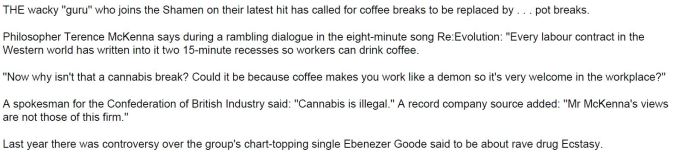
Another related favorite item (this time from the digital archives) is a short article that appeared in the London newspaper, The Daily Mirror, on March 10, 1993.

LDM

I always find it particularly amusing that the author of this article actually contacted “a spokesman for the Confederation of British Industry” to get an official comment on Terence’s suggestion that the working man’s coffee breaks be replaced with cannabis breaks. Cannabis is, of course, still illegal in the UK, 24 years later.

The main item from the archive, though, that I’d like to profile today on the blog is a recently acquired issue of a British music magazine called New Musical Express from February 27, 1993. This issue of NME features The Shamen on the cover and includes a two-page spread article featuring commentary on the band and its recent endeavors and controversies, focusing particularly on their collaboration with McKenna, and includes excerpts of discussions with Terence and co-founder of The Shamen, Colin Angus. Photos are by Steve Double (who I have contacted to inquire about other photos from the shoot). I’ll include some excerpts from the article below the images.

…the bloated, festering music industry has shown itself to be moribund by the debacle of this year’s Brits Awards…

…What kind of decidedly crazy people only give awards on sales merits when their vested interests are involved and refuse to even acknowledge true rags-to-riches tales like that of The Shamen? Why, the committee of money-driven, power-hungry major label movers and shakers of course…

…But Colin Angus and his verbal sparring partner Terence McKenna aren’t fazed today — Colin just feels snubbed by the industry…

…Terence McKenna’s creased face breaks into a huge grin — he’d love to have performed ‘Re-evolution’ with The Shamen at the awards ceremonies and disturbed the peace.

His eyes are twinkling, limpid pools of light. They seem suffused with a thousand years of knowledge. His demeanour betrays  a near-lifetime of psychedelic drug ingestion. His voice is a deep, rich, cracked volcano and, in his presence, you feel other-worldly, as if you’re making contact with previously undiscovered alien beings who understand you but whom you can’t understand.

This is Terence McKenna, author, shaman, voyager into the unknown…and not your average acid casualty. A thorn in the side of polite society, a crusader for change, and the spoken-word star of the new single by The Shamen, he’s spooning his chicken curry in London’s East End and offering pearls of wisdom.

Terence: “My approach to this stuff is political and I see this stuff as a vehicle for propaganda. And this youth culture is very astute on how bankrupt the values of the middle-class are. What are they going to have handed on to them? The whole planet has been looted right in front of them. So, getting this kind of message out is empowering an underclass that is going to inherit the world.”

Who is this mild-mannered man who never raises his voice, this American with a 14-year-old son who gets him to listen to grunge and house music when they’re not going out to see Ice-T films together? And what is he doing with one of our highest-profile pop groups, The Shamen, who strive to question the unquestionable when they’re not perfecting bite-sized snippets of electronic gospel…

Terence McKenna…is much more open to music and experience. He doesn’t see Western people with painted faces dancing around a fire as shamen, but people who hold great sway over other people through the healing power of music. And he tries to make mincemeat of my arguments against psychedelic drugs. The reason why most people don’t take these drugs, I proffer, is because they fear for the effects; not necessarily the short-term effects, but the long-term effects, which are largely unknown.

“I think people don’t take them because the establishment has misinformed them, he counters… This is the recovery of the way religion was done for the first million years after it was invented. And it’s just been in the last 500 years of European civilisation that people have become so phobic of the unconscious, of their own minds, that they’ve tried to legislate everything but a waking sleep out of existence.”

Terence: “Society picks and chooses the drugs it exalts, usually to serve a social system that is not our friend, but the friend of the people who are profiting off the social system.”

We have an interesting discussion on the class system — during which Colin and Terence relish abolition of the monarchy — and a heated debate on Christianity.

Colin: “The apocalypse is going to start happening in the beginning of the next century, the next millennium. At least the start of it, anyway. And it’s basically going to be the collapse of the global capitalist economic system, competition for dwindling resources and basically the results of there being too many people on the planet.”

Don’t you have any optimism for the future?

“I do believe that those of use, the people that do survive, that it will be a new beginning for us, a positive transformation.”

DSCF8469

DSCF8476

The Invisible Landscape Reviewed in Library Journal in 1976

On May 1, 1976, Library Journal published a review of a book written by brothers Terence and Dennis McKenna. This is, so far as I know, the first-ever published review of the McKenna brothers’ first book, The Invisible Landscape: Mind, Hallucinogens, and the I Ching, and is the only proper ‘review’ of the first edition (1975) of this book (as I mentioned in a recent post, Robert Anton Wilson also devoted several pages to a treatment of “the McKenna theory” in his 1977 book, Cosmic Trigger: The Final Secret of the Illuminati).

As I’ve also mentioned in a previous post, Library Journal was created in 1876 by Melvil Dewey, creator of the Dewey Decimal System, as a trade publication for librarians. All of Terence’s books and a few of his published talks have been reviewed in Library Journal over the years (and will eventually be featured here in the archival blog).

This 1976 review, by Nathan Schwartz of the New York Association for Analytical Psychology is among the more positive of the reviews of Terence’s work that appear in Library Journal and is notable particularly because of its early date when Terence (and Dennis) would not have had any other reputation. This is essentially their first public exposure, a positive public exposure, and in a well-established and highly-circulated publication. Finally, it is also worth noting that The Invisible Landscape is, here, reviewed under the heading of ‘Science/Psychology’ (also, the ‘experiments’ were with psilocybin mushrooms and banisteriopsis caapi, not ayahuasca as Schwartz states, as I’m sure you know–it’s very important in Terence’s life story that the experiment was with mushrooms). Here’s Schwartz’s review:

A unique work, difficult in subject matter yet well worth the reader’s effort. Using data from their experiment at a tiny mission settlement in the Upper Amazon Basin with the drug ayahuasca, the authors embark on a tour de force of quantum mechanics, biochemistry, psychiatry, holography, and then the I Ching, with the purpose of demonstrating that “‘thought’ or ‘consciousness’ has its physical basis in quantum mechanical phenomena.” It is a “free-wheeling series of speculations” indeed, but a process that is witness to the vast internal resources of the archetypes that the authors tapped through their drug-induced experiences. This new consciousness has its fruition in a novel understanding of the I Ching, and through this an approach to the mathematics of form. The book breaks new ground, and casts much that is known in a new form. Important for psychologists, chemists, and physicists.

–Nathan J. Schwartz, New York Assn. for Analytical Psychology

Schwartz001Schwartz002

R.A.W. Day 2017 and the Art & Comics of Bobby Campbell

I had the pleasure, last month, of attending an event in Santa Cruz, California for R.A.W. Day. If you don’t yet know that R.A.W. stands for Robert Anton Wilson, you’re in luck, 20228226_10154605472820825_770752162685430355_nbecause you have a new, and truly peccable, author/thinker/comedian/entity to explore–one that I suspect you will find, in one way or another, of substantial interest. Here’s one place to start (there are others, and plenty of youtube videos). R.A.W. had an incredibly important influence on the contemporary countercultural milieu in a huge number of areas (from interpretations of quantum physics to conspiracy theory to the promotion of ‘invented religions’ to transhumanism and on and on), including many areas of overlap with Terence McKenna.

In fact, it was Wilson who seems to have been the first to notice and write publicly about The Invisible Landscape, the first edition of which was published in 1975. In R.A.W.’s 1977 classic Cosmic Trigger Vol. 1: The Final Secret of the Illuminati, he devotes several pages to a treatment of the McKenna Timewave alongside several other theories of cultural/temporal acceleration (such as those by Timothy Leary, Buckminster Fuller, and Alvin Toffler).

This, indeed, is the thesis of a remarkable book offering the final set of models and metaphors which we shall be discussing… The McKenna brothers, who between them have a background that includes anthropology, biology, chemistry, and botany, conducted a metaprogramming experiment in the Upper Amazon Basin, using the local “magic mushroom.”… The McKennas regard our universe as a hologram, every part contains the information of the whole… There are 64 time-scales in the hologram of our universe [derived from the 64 hexagrams of the I Ching]… The action of psychedelics, in the model, opens the quantum information system… Within the McKenna theory, all of the 64 time-scales peak together… There is a 4,300-year cycle from urbanization to the dawn of modern science; a 384-year cycle in which science has caused more upsurge of novelty than in that 4,300 year cycle; a 67-year cycle […] in which there will be more acceleration than there was between Galileo and Hiroshima; a 384 day cycle in 2011-2012 when there will be more transformations than in all previous cycles; a 6 day cycle […] and so on, down to a grand climax… That is, in the last two hours before Peak, we will achieve 18 extensions of consciousness and power, each one comparable to the passing from Earth to Space. And in the last .0075 seconds of the Great Cycle we will pass through 13 such transformation… As the McKenna’s say, it is hard to avoid hyperbole in trying to contemplate what this means.
Wilson also included entries on Terence and his book Food of the Gods in his own encyclopedic Everything is Under Control. Another review of Food of the Gods by R.A.W. can be found in the edited Chaos & Beyond: The Best of Trajectories  book (or in the original Trajectories newsletter #10–if you have a copy and would be willing to scan it and send me the files to add to the archives, that would be amazing!–if you have a physical copy that you’d like to send, that would be even more incredible!!). I’m also completely missing a discussion of Terence’s Timewave by R.A.W. that appears in Trajectories #7 (again if you have a copy, please do send scans).
Terence and R.A.W. appear side-by-side in many magazines, anthologies, and interview collections (like David Jay Brown’s Mavericks of the Mind). Both also traveled to Portugal to appear in Edgar Pera’s ‘LX94: Manual of Evasion’ film along with mathematician Rudy Rucker. Here’s Terence getting his makeup done:
TMMakeup
And R.A.W. (with his iconic ring–and accent) making a phone call:
RAWPhone
These photos and this outtake of Terence describing a monument to Portuguese navigators are from Rucker’s own home video of the experience. There’s some great intimate footage of both R.A.W. and Terence in Rucker’s video (including a shared joint), although it also seems evident that both grow a bit tired of the relentless behind-the-scenes recording, Wilson at one point exclaiming to the behind-the-camera Rucker, “Are you at it again?” before launching into a characteristically dirty limerick:
There was a young gaucho named Bruno
And he said about sex, “There is one thing I do know.
   Women are fine,
   And boys are divine,
But, iguanas are numero uno!”
Wilson and McKenna also both spoke at a significant psychedelic conference in 1991, called the Bridge Psychedelic Conference. Much more could be said about this conference, but it’s a bit of a tangent in this context, so I’ll just drop a link here to what I take to be one of Terence’s most significant, relevant, and rare topics of discussion from the conclusion to that event. He starts by mentioning a discussion the previous day between R.A.W. and Timothy Leary:
However, after all of that establishment of connections between Robert Anton Wilson and Terence McKenna, let me get back to the R.A.W. Day event in Santa Cruz last month and the archival material that came out of it. There were quite a few friends and acquaintances of Terence in attendance and among the speakers, including Erik Davis, David Jay Brown, R. U. Sirius, Nick Herbert, Robert Forte, and others, including Daisy Eris Campbell, the producer of ‘The Cosmic Trigger Play’ in the UK (if you’d like to see the play come to the U.S. and have any space, resources, etc. to help make it happen, send me an email, and perhaps I can help in some way) as well as representatives of Hilaritas Press, who have taken over the re-publishing of R.A.W.’s books. It was a very tight group and a wonderful day of both reminiscence and forward thinking. I made a number of great connections, which will undoubtedly bear fruit for the archives down the line. And, although I’ve spent most of the blog post on a range of related tangents, it is one of those connections that I’d like to highlight here.
I did actually also acquire some relevant material for the Terence McKenna Archives at the event, from creator of comix, art, and zines, Bobby Campbell. Campbell’s work shows that he’s deeply steeped in the counterculture–he includes mash-ups of material from across the spectrum but does so in a way that remains firmly his own. He wanted to make sure, particularly, that a copy of his comic book, Agnosis, made its way into the TM Archives. While Agnosis is dedicated to and much more clearly influenced by and Robert Anton Wilson, Terence’s stamp is clearly evident throughout, as well, from the title of Book One: “#FINDTHEOTHERS” to parts of the eschatological framework (including a computer program called Timewave Aleph and discussion of “the transcendental object”), among other linguistic clues that will be obvious to those who have spent a lot of time listening to McKenna talks. So, thanks, Bobby, for making sure that copies of your work made into the archives. I’m definitely looking forward to seeing what continues to pop out of your Weirdoverse!
You may also have seen Bobby’s Terence art pieces floating around the web, but if not, here you go. The Trialogues image comes from an interesting trialogue (available on disinfo) Campbell himself had by email with Ralph Abraham and Rupert Sheldrake.

Terence McKenna in Werner Weicke’s ‘Apocalypse: Revelations for the New Millennium’

I’ll keep this one short. In 1998, Mystic Fire Video released a 5-video set called Apocalypse: Revelations for the New Millennium created by director Werner Weicke. Terence McKenna made a brief appearance in part one of the series, titled A Vision of the End. Although the videos were released in 1998, it’s possible that the recording of McKenna took place earlier as he sets the year of the eschaton, 2012, “20 years” into the future, which would suggest a recording date somewhere around 1992. Either way, I don’t believe that this short clip has been shared online before. So, here you go. Enjoy!

Terence McKenna Archives – Random Item #29 – Paul Krassner’s Further Weirdness with Terence McKenna

In an earlier ‘weekly haul’, I mentioned that the archives received a copy of Paul Krassner‘s book Murder at the Conspiracy Convention and Other American Absurdities, which contains Krassner’s interview with Terence under the title ‘Further Weirdness with Terence McKenna’. The same interview appears, with slightly different edits each time, in two of Krassner’s other books: Sex, Drugs, and the Twinkie Murders and Magic Mushrooms and Other Highs. The latter two books contain an extended Q&A (“in person and by e-mail”) that doesn’t appear in Murder at the Conspiracy Convention. The interview originally appeared in High Times #266 (October 1997) under the title ‘The Mushroom Apocalypse of Terence McKenna’.

The item that was selected through the random number generator for today is the 2nd edition of Magic Mushrooms and Other Highs (the 1st edition was self-published by Krassner). I don’t own a copy of either edition (I’ve never seen a copy of the 1st), but I was able to scan the relevant pages of a copy just to make sure that it is at least digitally represented in the archives. If you’d like to donate to help acquire a copy, which I’ve found online for $13.92, you can do so at the Transcription Project or through our crowdfund store (I’ve also found a copy of the original High Times for $9.97). Rather than continue to have individual blog posts for each of Krassner’s books that contain the interview, I am just going to finish out the series here with one final post about all of them, including some selections from the interview. I almost encountered Paul Krassner a few days ago at a Robert Anton Wilson event in Santa Cruz (about which I will post more soon), but he was was unable to attend. In the meantime, these are where you can find his interviews with Terence McKenna…Also of note is the Dedication to McKenna in Magic Mushrooms and Other Highs:

And, some excerpts from Krassner & Terence (passages set off by quotation marks are McKenna’s words):

With his curly brown hair and beard, a twinkle in his eye, and a lilt to his voice, he could easily pass for a leprechaun.

“I’m convinced that probably for most people, the most important thing in a workshop is nothing that I will say or do, but who you might meet here.”

He is a psychedelic adventurer and visionary author who serves as a missing link between botany and technology.

He handles the role with intelligence, grace, and humor. In person, he is spontaneously charming and effortlessly witty. He loves language, and though he is glib without being speedy, he chooses his words carefully. He communicates with the precision of an architect and the passion of a poet, speaking in a friendly, entertaining twang. He is, in short, a Mr. Rogers for grown-ups, and the neighborhood he welcomes you to explore is your own inner space.

Krassner describes an incident that occurred in San Francisco following the Saint Stupid Day Parade and a fundraiser event for Jack Kerouac’s daughter, Jan, in which he was arrested for possession of a bag of mushrooms that he hadn’t entirely been aware that he had possessed. It was, apparently, that incident that prompted his mission to meet and talk with Terence McKenna, which led to the present interview:

The cop’s question–“So, you like mushrooms, huh?”–was asked with such archetypal hostility that it kept reverberating inside my head. So you like mushrooms, huh? It was not as though I had done anything which might harm another human being. This was simply an authority figure’s need to control. But control what? My pleasure? Or was it deeper than that? This need to understand the basis of my plight became the impetus for my decision to meet Terence McKenna. He was, after all, the Head Mushroom Guru.

I contact McKenna in Hawaii, where he lives in happy isolation. “My website is on a machine in the Bronx, although I administer it from the Big Island.”

The workshop convenes… Everybody has arrived with their own personal agenda, and each will hear McKenna through their own individual filter.

Someone else publicly confides to him, “If my life were a ride through the fun house at Disneyland, you’re like one of the characters who keep popping up.”

McKenna confesses, “I’m an epistemological cartoon.”

“Why is there so much social tension over this psychedelic issue? Nobody who has informed themselves claims that great criminal fortunes are being made or that kids are being turned into psilocybin runners in the ghetto. We know that all the stupid reasons given for suppressing psychedelics are in fact some kind of lie.”

“Strangely enough, the way you cheat the grim reaper is by living as fast as you can, because all time is [is] the seriality of events, and the more events there are, the more time you have, so awareness becomes very important, and even, as the Buddhists say, awareness of awareness.”

Saturday morning at Esalen. Fresh fruit and vegetables galore. Hot cereal and stewed prunes. People will be passing gas all over the place…

McKenna maintains that “There are not good beliefs, there are just bad beliefs, because they inhibit human freedom.”

“Our legacy is the legacy of the children of the stoned monkeys.”

“If yoga can do it, great. If Transcendental Meditation can do it, great. The pope and the Dalai Lama, fine. But, in my experience, the only thing that changes consciousness as fast as we’re going to have to change it is psychedelics. We have to change it on the dime, because the processes that we have set in motion are going to drag us down.”

“We need to unify heart and head in the presence of super technology.”

“If psychedelics are so great, then what’s so great about us? Are we better than those poor people who have never taken psychedelics? Are we morally better? Are we wiser? Or are we just some kind of screwball cult like Mormons, who congratulate themselves on having achieved this supreme understanding, and yet to everybody else they just look like geeks? And we look like geeks. This really is a problem I carry with me, because I’ve advocated psychedelics my entire life, yet I often see incredibly bad behavior and stupidity and cruelty and insensitivity committed by psychedelic people.

The bottom line of psychedelics is not how good it makes you feel but how creative you are, and the acceleration of creativity that is taking place is immense, and if you can get off with the people who are responsible for most cutting-edge phenomena, they will admit that they began with psychedelics.”

“I really believe our evolutionary past holds the key to our evolutionary future.”

“The end of the Mayan calendar is the same day that I had calculated [archivist’s note: this is not actually true]. Well, this is not a reason for believing my theory, for you, but for me it was a reason. Too weird a coincidence. The only thing that I have in common with the Mayan civilization is that we both used psilocybin, and it’s almost as though when you purge the virus off your disc, there is at the bottom line, written in assembly code that cannot be expunged, a discard date that says, ‘Abandon this locality before December 21, 2012 AD.”

Someone else asks, “What book are you currently reading?”

I’m reading a book , it’s a hoot, Time Machines: Time Travel in Physics, Metaphyics, and Science Fiction by Paul Nahin. It’s published by the American Institute of Physics, so you need not hang your head in the subway.”

Another person asks, “How’s your website coming?”

“I’m just so damned proud of having hacked it in the first place. The things we’re discussing here, if you go there and download, it’s all there in high detail, and you can take your time. I think of it–in terms of my intellectual life–it’s more who I am than who I am sitting here, because I might forget a reference or skip over something. On the website, we got it right.”

Except that on the website you can’t appreciate McKenna’s speech patterns. He would pronounce pat-tern, as though his inner dictionary were separating syllables, certainly a shat-tering experience.

“Aliens don’t talk to individuals, they talk to species. And they don’t say things like, ‘Be vegetarian,’ the say things like, ‘Now do language. Now physics.'”

“[The universe] wants to conserve novelty at all costs. That seems to be more important to it than conserving biology. It will sacrifice biology if necessary to save novelty. Novelty is the top of the value hierarchy, as I see it, and biology, culture, technology, physics–all are simply means to an end.”

And, Krassner adds his own thought to the matter:

I remember the first time I came to Esalen, in 1970, for a workshop with John Lilly. He played a tape loop of one word being repeated continuously, but after a while you would begin to hear other words.

“When faced with repetition,” Lilly explained, “your human biocomputer automatically programs in novelty.”

“Finally, after I had alarmed a number of people, and my friends were meeting, speaking of intervention–on an idea for god’s sake–Ralph Abraham came to see me on his own, he wasn’t delegated by the interventionists, and said, ‘The problem here is that you have an occult diagram. Only you understand it, and only you can interpret it, and therefore it’s not very persuasive.”

“For me, this [discussion of the Timewave] is sort of the payoff of doing these weekends. In the other parts of the weekend, I basically function as the nutty professor. This is so personal that no one has ever tried to steal it. That’s how uniquely and wholly and totally mine it is. So if it’s malarkey I get all the blame, and if it’s true I get all the credit.”

“For those of you who are true fans of predictive accuracy, the day of the Human Be-In, January 13, 1967, is the day we go over the hump… We’re right about here [in the late 90s]. This is the pause before the storm. This is the most habituated moment that we will know for maybe the rest of time.”

“I suppose if I were a different kind of personality,” McKenna observes, “I would haunt the hallways of major universities and try to drag these guys into my theory. But for some reason, I think the Timewave itself empowers a certain kind of fatalism, and I just say if I’m right, I’m right; if I’m wrong, I’ve probably told enough people already.”

When Krassner asked Terence about the recent Heaven’s Gate mass-suicide:

“I encountered Do (then Bo) and Peep in 1972. They were contemptible, power-crazed new age creepoids then, and apparently things didn’t get better.”

When Krassner asked Terence about the “posteschaton”:

“I’ve created a series of scenarios in ascending weirdness which answers the question.

A low weirdness answer would be, suddenly everyone begins to behave appropriately. This is kind of a Buddhist, Taoist approach…we would just dissolve into appropriate behavior. Since we’ve never had that, we can’t imagine what it would be like.

Then there’s the transformation-of-physics scenario, which basically says, ‘All boundaries dissolve.’ What that would probably be like, the first hour of it would be like a thousands micrograms of LSD. After that, we can’t imagine or predict, because again it would have so totally changed the context…

Then there are the catastrophic scenarios that revolve around the question, “Death, where is thy sting?” And probably the most efficient of those is the planetesimal-impact scenario. A very large object strikes the earth and kills everybody, and that’s it…[or] the sun will explode. that would certainly clear the disc and fulfill the whole thing. The planet vaporizes, and collectively we and all life on earth move into the shimmering capsules of the post-mortem realm, whatever that is. Novel, novel.”

“The rise of the Web has been a great boost to my fantasies along these lines, because now I can see with the Web from here to the eschaton. Apparently, it’s a technology for dissolving space, time, personality, and just releasing everybody into a data stream, something like the imagination.”

One idea I have for an end-of-history scenario: Time travel becomes more and more discussible; finally there are laboratories working on it; finally there is a prototype machine; finally it’s possible to conceive of a test; and so on the morning of December 21, 2012, at the World Temporal Institute headquarters in the Amazon Basin, by a worldwide, high-definition, three-dimensional hook-up, the entire world tunes in to see the first flight into time. And the lady temponaut comes to the microphone and makes a few brief statements, hands are shaken, the champagne bottle is smashed, she climbs into her time machine, pushes the button and disappears into the far-flung reaches of the future. Now, the interesting question is, what happens next? And I already established for myself that you can travel backward into the past, but you can’t travel further into the past than the invention of the first time machine, for the simple reasons that there are no time machines before that, and if you were to take one where there are none, you get another paradox.

So, what happens when the lady temponaut slips into the future? Well, I think what would happen a millisecond later is tens of thousands of time machines would arrive from all points in the future, having come back through time, of course, to witness the first flight into time…And that’s as far as the road goes. That’s the end of the the time road.

[And, here, Terence goes even beyond this “normal” explanation of his]

But the grandfather paradox persists. One of those time travelers from 5,000 years in the future, on their way back to the first time-travel incident, could stop and kill his grandfather, and then we have this whole problem all over again. So, I thought about this for a long time, and I think I’ve found a way around it. But, as usual, at the cost of further weirdness.

Here’s what would really happen if we invented a time machine of that sort. The lady temponaut pushes the button, and instead of all time machines appearing instantly in the next moment, in order to preserve the system from that paradox, what will happen is, the rest of the history of the universe will occur instantly. And so that’s it. I call it the God whistle.

This is because you thought you were building a time machine, and in a sense you were, but the time machine isn’t what you thought it was. It caused the rest of time to happen instantaneously, and so the furthest-out developments of life, matter, and technology in the universe come right up against you a millisecond after you break that barrier, and in fact your discovery that traveling time is not traveling time, it’s a doorway into eternity, which is all of time, and that’s why it becomes more like a hyperspatial deal than a simple linear time-travel thing.”

y7y1y

Terence McKenna Archives – Random Item #28 – Hallucinations on the Archaic Revival

Today’s random item from the Terence McKenna archives appeared in a magazine called Psychedelic Illuminations (which later became TRP: The Resonance Project, which later became Trip Magazine, which later became Tripzine.com). Our item of interest appeared in Psychedelic Illuminations #8 (Winter 1995/1996). It is, in fact, a rather curious item that is, in many ways, a very odd thing to publish, and, in other ways, is an exercise that perhaps many of us can sympathize with. Barry Klein, writing under the pseudonym Runyan Wilde, has created a sort of reverse pseudo-interview with Terence McKenna using TM’s written and spoken words from other interviews to provide a basis for Wilde’s further commentary, sometimes at odds with McKenna and sometimes in qualified agreement. In other words, Klein (as Wilde) essentially presents his own commentary on a range of Terence’s thoughts as expressed to earlier interviewers.

Here are some excerpts from Runyan Wilde’s ‘Hallucinations on the Archaic Revival’–you can download a PDF of the entire “interview” here:

[P.S. – This is another publication that the archives does not possess a physical copy of, which also includes an essay by Terence–below are photos I took of someone else’s copy. I have found a copy available that will cost the archives $18.99 to acquire. If you would like to help fund the acquisition of this item, please donate directly at the Transcription Project website or make an order from our crowdfund shop. Thanks for your help!]

I intend my comments, taken from my own favorite paradigms, to arouse thought and discussion, not as statements of some real “Truth” in contention with Terence’s ideas…

I think mysticism is not something that happens to you, I define it as a precisely  ordered set of disciplines from within, within the outlines of a specific set of paradigms. This should distinguish our version from the jumbles of neo-occultism and empty ritualism. I believe that what Terence is referring to as mysticism must be more the experiential sense of wonderment and transcendence enjoyed in the rich psychedelic journey.

98% of the experiences people have with psychedelic substances [are not mystical], because they are mostly devoid of purpose and context.

Much of our scriptures and mystical literature are attempts to describe what was seen and experienced in altered states of consciousness.

Terence has fallen back into psycho-political-social philosophy, which is not of the same order as psychedelic consciousness.

This phenomenon–the voice in the head–can be both a blessing and a curse. It’s true, the information is outside of ordinary personality, but that in itself does not make the source reliable, nor prove that there are extraterrestrials or transdimensional elves, whom I rather distrust anyway… What is necesary is self-reliance without self-importance, because then we can compare what we are seeing and hearing to our larger experience without getting hooked by the amazing seductions these dimensionalities can come up with.

There have been some good bridges built by the New Age, but now it has fallen derelict, with shoddy mediums channeling while they drink beer, disciples of hidden (non-existent) masters peddling their techniques for a thousand dollars, and earnest devotees spending years of their lives building replicas of spacecraft whose description was channeled to them.

The reason shamanic traditions personify Death (capitalized here for that reason) is that, in order to be able to navigate on the other side, the shaman must form a personal relationship with his own impending Death.

Diddling with entheogens is an insult to oneself as well as to the Spirit…however, I have seen enough wasted, and toxic, “heroic doses” to realize that merely taking a high dose of something does not guarantee any breakthroughs, visions, or realizations, and I have seen (and experienced) penetrating results from ridiculously low doses, including none at all…

Nature by itself cannot be the guide, since its purposes might be best served by no one’s awakening or breaking free of the ordinary mold, but everything we’ve talked about points to the notion that the only thing that we have to rely on is our individual relationship with Consciousness itself, not any external substance, nor its dosage, nor its history, nor “reasonable social values.” Many of the shamanic cultures have some despicable social values like mutilation, torture, human sacrifice, eating the brains of the dead, circumcision of young girls and endless tribal warfare–not so very reasonable, I’d say.

Why would you wish to integrate human and machine intelligence? There is no machine intelligence other than what some particular human intelligences put into it in the first place. Terence is still laboring under the notion that it will be mechanistic science that leads us, the human race, into that amazing hyperworld of the future, while elsewhere he acknowledges that science fails miserably with the ineffable. Terence, are you planning on selling us a computer program that will give use the measliest cullings of that which is our birthright as humans with consciousness? Why would I buy a program when I can see for myself directly for the price of a couple of mushrooms or a few tokes of DMT, and ultimately with just proper training?… The very shamanic cultures that Terence is supposed to have studied do plenty of transmogrifying without defining themselves as bits and bytes. I thought we were looking for a more wholistic paradigm.

Runyan Wilde, who has been studying the mysteries all his life, is the author of psychedelic poetry, social commentary. Under another name, he has made some fifty radio broadcasts and given numerous on personal transformation and mysticism. He is not what you’d think, and yet he is.